Meeting the requirements of IS EN 1997-2:2007 for ground investigation isn't optional when developing in Waterford—it's the foundation of a sound project. The underlying geology here shifts dramatically from the Carboniferous limestone bedrock near the Viking Triangle to the alluvial clays and silts along the River Suir. An exploratory test pit cuts through the guesswork. Rather than relying solely on borehole data, a physical excavation lets our engineers observe the strata, take undisturbed samples, and assess groundwater ingress directly. This approach often proves decisive on constrained urban plots off the Cork Road or in the residential extensions spreading through Ferrybank, where access for larger rigs is tight but the need for reliable bearing capacity data is absolute. For projects requiring deeper refusal verification, we frequently combine this with SPT drilling to correlate shallow observations with penetration resistance at depth, ensuring the full soil profile is understood before a single foundation is poured.
A one-day test pit investigation in Waterford's variable glacial soils can often give you more actionable geotechnical data than a week of desktop study.
Technical details of the service in Waterford
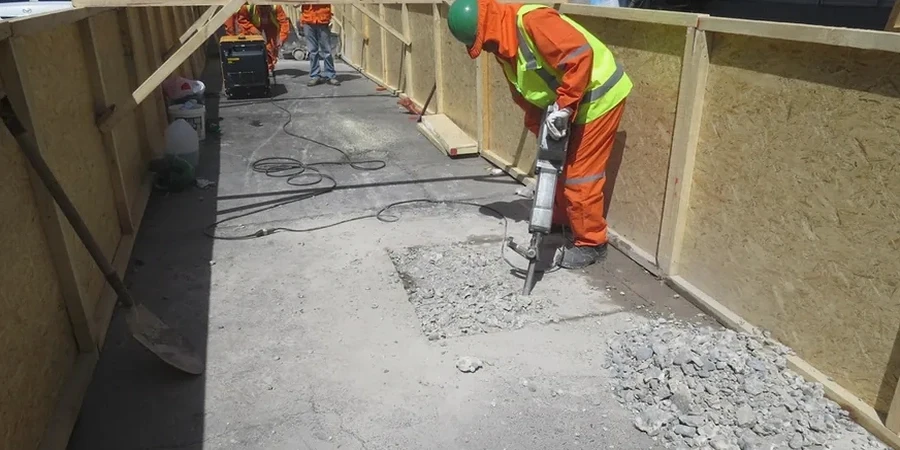
Local geotechnical conditions in Waterford
Waterford's urban core sits on a complex sequence of river alluvium and estuarine deposits, with the water table often lying just a metre or two below ground level. A shallow excavation that isn't properly supported in these silty clays can collapse within minutes, especially during a wet winter when the Suir is high. The risk isn't just to the investigation crew—it's to the adjacent structures, some of which date back to the 18th century. An unshored exploratory test pit in saturated ground can undermine a neighbouring wall footing before anyone realises what's happening. We tackle this by designing stepped or battered excavations where space allows, and by using trench boxes where it doesn't. The safety of the public and the integrity of Waterford's historic streetscape dictate that every pit is backfilled and compacted the same day it's opened, leaving no trace of the investigation.
Our services
Every test pit we open in Waterford is planned to answer specific design questions, not just to tick a box. We focus on practical outcomes: verifying bearing strata, locating buried works with vacuum excavation, and sampling for environmental compliance.
Bearing Verification Pits
Excavated to foundation formation level, typically 1.2 to 3.5 metres, to visually confirm the stratum type and take hand-cut samples for laboratory shear strength testing. Essential where the glacial till cover is thin and rockhead varies unpredictably across the site.
Percolation and Drainage Test Pits
Dug to assess soil permeability for on-site wastewater treatment design, a common requirement for rural one-off housing in County Waterford. We follow the EPA Code of Practice, recording the water drop rate over time to size percolation areas correctly.
Questions and answers
What does an exploratory test pit cost in Waterford?
For a standard investigation involving one or two pits up to 3 metres deep, with machine hire, operator, and an engineer to log and sample, the range is typically €490 to €840. The final figure depends on access constraints, whether you need vacuum excavation to clear works, and the volume of laboratory testing you request on the samples we recover.
How long does it take to get results from a test pit?
The excavation and logging are completed in one day on site. You get a verbal summary and the field log immediately. If we send samples to our ISO 17025-accredited lab for strength or classification testing, the full report is generally ready in five to seven working days.
Is a test pit enough for a house extension in the city, or will I need a borehole too?
In many Waterford city plots, where the founding stratum is a known gravel terrace at shallow depth, an exploratory test pit is sufficient to satisfy building control for a single-storey extension. If the pit reveals deeper soft clay or fill, we might supplement it with a dynamic probe or shallow borehole: we advise on this once we see the ground.