With over 54,000 residents and a road network extending through Waterford’s glacial till valleys, the difference between a pavement that lasts 20 years and one that fails in five often comes down to a single number: the CBR value. Our laboratory CBR test gives contractors and consulting engineers in Waterford the precise subgrade strength data required by Transport Infrastructure Ireland (TII) standards, eliminating the guesswork from pavement thickness design. Whether you’re widening the N25 approach or laying out an industrial estate access road near Belview Port, soaked CBR values under worst-case moisture conditions are what the local authority expects to see in your design submission. We complement the laboratory CBR programme with in-situ density testing when compaction verification is required on Waterford’s variable clay-sand subgrades, ensuring the as-built condition matches the design assumption from day one.
A 96-hour soaked CBR test on a Waterford glacial till can deliver a value three times higher than a presumptive desk-study figure — that difference alone can reduce pavement thickness by 100 mm or more.
Technical details of the service in Waterford
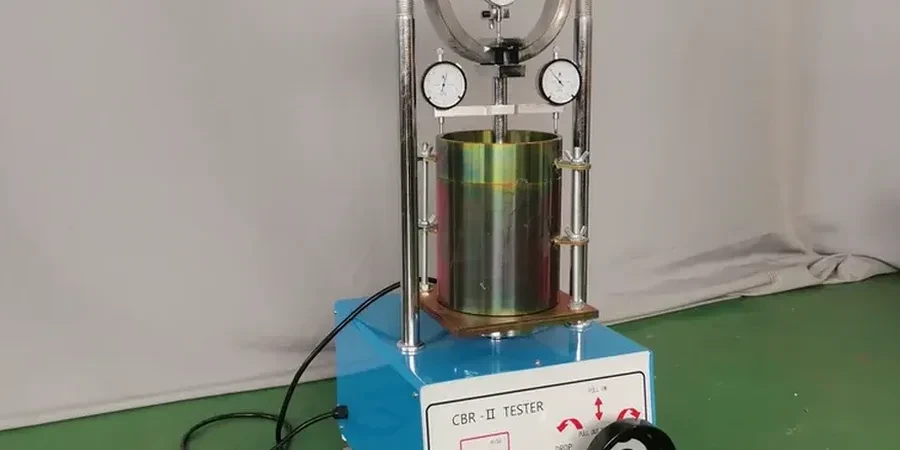
Local geotechnical conditions in Waterford
Waterford’s subgrade geology is dominated by glacial tills and alluvial deposits along the River Suir corridor, where perched water tables and seasonal saturation cycles create precisely the conditions that degrade subgrade strength over time. A pavement designed on unsoaked CBR values — or worse, on visual classification alone — absorbs moisture through cracks and joints, progressively losing bearing capacity until rutting, fatigue cracking, and structural failure appear within the first three to five winters. The TII pavement design method explicitly requires soaked laboratory CBR testing for this reason, and Section 50 applications for new access onto national roads will be returned with a request for CBR data if the submission lacks it. On brownfield sites near Waterford’s quays, where historical fill materials may include ash, clinker, or dredged silt, the soaked CBR can drop below 1.5%, triggering the need for stabilisation or a capping layer that the budget must accommodate from the outset — not discover during construction when the options are expensive and the programme is already under pressure.
Our services
Our Waterford geotechnical laboratory runs a dedicated CBR testing programme that supports pavement designers, local authority road schemes, and private development access roads across the South East. Each test programme is tailored to the specific material and expected groundwater regime.
Soaked CBR Testing (96-Hour)
The standard test for TII pavement design. Specimens are compacted at optimum moisture content, submerged under a surcharge weight, and soaked for four days before penetration. We report CBR values at 2.5 mm and 5.0 mm penetration with full load-penetration curves.
CBR with Proctor Compaction
Before the CBR test can proceed, the material’s compaction characteristics must be established. We run the Proctor test — typically 2.5 kg rammer for fine-grained soils or 4.5 kg for granular materials — to determine the maximum dry density and optimum moisture content that define the compaction target for CBR specimen preparation.
Subgrade Assessment Packages
For larger road projects or site investigations with multiple trial pits, we combine laboratory CBR testing with particle size distribution, Atterberg limits, and moisture condition value (MCV) testing to deliver a complete subgrade assessment report aligned with TII documentation requirements for pavement foundation design.
Questions and answers
How much does a laboratory CBR test cost in Waterford?
A single-point soaked CBR test including Proctor compaction and 96-hour soaking typically ranges from €120 to €190 in Waterford, depending on the number of points and whether additional classification tests such as Atterberg limits or particle size distribution are included in the same programme. We deliver a fixed-price quotation before any work begins, with no hidden charges for the soaking period or reporting.
Why does TII require soaked CBR values rather than unsoaked?
Soaked CBR testing simulates the worst-case moisture condition that the subgrade will track record over the pavement’s design life — specifically, prolonged wet periods when the water table rises and drainage systems are under maximum load. An unsoaked CBR value can be two to four times higher than the soaked equivalent, and designing on the unsoaked figure produces a pavement section that will fail prematurely once the subgrade becomes saturated during Waterford’s wet winter months.
How many CBR samples do I need for my site investigation?
The number of CBR samples depends on site variability and the length of the proposed road or pavement area. TII guidance suggests a minimum of one CBR test per material type encountered; on a typical Waterford site with glacial till, we recommend at least three CBR points spaced across the footprint to capture lateral variation. For linear schemes longer than 500 metres, we generally recommend one CBR test per 200–300 metres of alignment, with additional points where the soil profile changes.
What is the difference between laboratory CBR and in-situ CBR?
Laboratory CBR tests are performed on remoulded, compacted specimens under controlled moisture and density conditions, giving the designer a repeatable baseline for pavement thickness calculation. In-situ CBR tests, such as the dynamic cone penetrometer (DCP) correlation method, measure the bearing capacity of the ground in its natural state — useful for verifying that compaction has been achieved, but not a substitute for the soaked laboratory value required by TII for pavement design. Both methods have their place, and we often use in-situ testing during construction to confirm that the design CBR assumption is being met.