The core barrel and casing advance slowly through Waterford’s estuarine clays, retrieving samples that tell a story of the River Suir’s historical meandering. In our track record, the city’s post-glacial alluvium and soft silts, which underpin much of the quays and the north bank, demand a particular respect when planning any underground work. A standard site investigation often misses the subtle transitions between the soft estuarine deposits and the underlying glacial till—a critical boundary for tunnel design. We routinely deploy instrumented drilling rigs capable of continuous sampling and in-situ testing to map these interfaces with the precision that a soft-ground tunnel in Waterford requires. This isn't about simply identifying 'soft soil'; it's about quantifying its behaviour under the stress relief and pore pressure changes that tunnelling inevitably brings.
Tunnelling in Waterford is less about the strength of the soil and more about managing the groundwater regime within the Suir's alluvial sequence.
Technical details of the service in Waterford
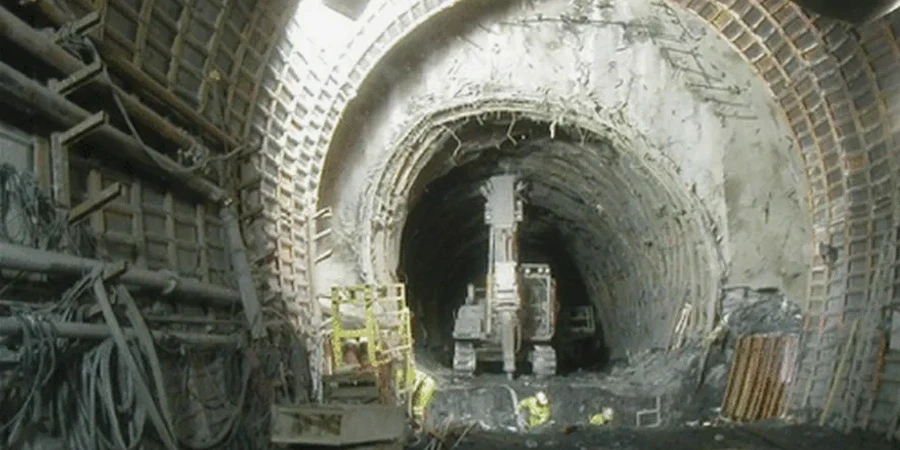
Local geotechnical conditions in Waterford
The Irish Standard I.S. EN 1997-2:2007, part of Eurocode 7, demands a thorough assessment of ground investigation adequacy, and in Waterford this is particularly relevant given the legacy of undocumented river crossings and buried works near the Suir. The most significant risk we see is not catastrophic collapse during boring, but rather the insidious settlement at surface level caused by tunnel face instability or poor tail-void grouting in the soft silts. A tunnel boring machine advancing through soft ground creates a ground loss that can propagate upwards, potentially damaging the historic quay walls and Georgian buildings that define the city’s core. We mitigate this by specifying real-time monitoring of settlement troughs and coupling it with a rigorous pre-construction assessment of building condition, ensuring the design is truly predictive rather than reactive.
Our services
Our analytical work for a tunnel in Waterford’s soft ground typically moves through a logical sequence, from establishing the geological baseline to predicting ground movements. We focus on the specific failure mechanisms that soft alluvium presents.
Advanced Laboratory Testing
We run multi-stage triaxial tests on undisturbed samples from the Suir Valley to define the stress-strain behaviour of the soft clays under unloading, which is the primary stress path for a tunnel crown.
Settlement Prediction Modelling
Using finite element analysis calibrated with our lab data, we model the trough width and maximum settlement for different TBM face pressures, directly protecting Waterford’s dense urban fabric above.
Ground Investigation Supervision
Our engineers supervise the site works, ensuring that the drilling in Waterford’s challenging mixed ground obtains the high-quality, undisturbed samples essential for a reliable soft-ground design.
Lining Material Specification
We deliver the geotechnical parameters—like the ground reaction curve and long-term creep potential—that dictate the required strength and flexibility of the tunnel’s permanent lining.
Questions and answers
What is the typical cost range for a site investigation aimed at a soft soil tunnel in Waterford?
For projects in the Waterford area, a targeted ground investigation and subsequent geotechnical analysis for a soft soil tunnel typically ranges from €3,730 for a focused supplementary study, up to €15,760 for a comprehensive campaign involving deep boreholes, extensive lab testing, and a full interpretive report.
How do you determine the face pressure for a TBM in Waterford's soft ground?
The required TBM face pressure is calculated by balancing the earth and groundwater pressures at the tunnel axis. In Waterford, the key challenge is the high water table within the Suir's alluvium, which often dictates a higher pressure to prevent blow-outs and limit the drawdown that could cause settlement.
Can you assess the risk of existing buildings settling during a nearby tunnel drive?
Yes, this is a core part of our analysis. We build a detailed geotechnical model of the ground and then apply empirical and numerical methods to predict the settlement trough. We then assess the predicted angular distortion against the building’s tolerance, a critical step for protecting structures like those along the Mall in Waterford. More info.