Waterford’s layered history—from Viking settlement to its Georgian quays—means the ground beneath the city holds more than a few surprises. The old river channels and estuarine clays of the Suir, combined with patches of glacial till, create subsurface conditions that can shift dramatically within a single site. Loose granular fills are common along the North Quays, where former docklands are being transformed. Our vibrocompaction design is built for exactly this reality. We map the density profile first, then specify the grid, energy, and depth needed to bring the ground to a uniform standard. A CPT test before treatment gives us the baseline, and follow-up testing confirms the improvement. For projects on softer zones we often pair vibrocompaction with stone columns to handle the transition between loose fill and underlying silt. The result is a prepared subgrade that meets Eurocode 7 requirements without over-excavation or imported fill.
Loose fill doesn't announce itself—it reveals itself when the slab cracks. Our design catches it before the concrete goes in.
Technical details of the service in Waterford
- Pre-treatment ground investigation with CPT and borehole correlation
- Energy and grid specification calibrated to target relative density (usually 70–85% Dr)
- Real-time monitoring of depth, amperage, and verticality during each probe
- Post-treatment verification by CPT, with before-and-after overlay comparison
- Compliance documentation aligned with I.S. EN 1997-1 and Eurocode 8 seismic provisions
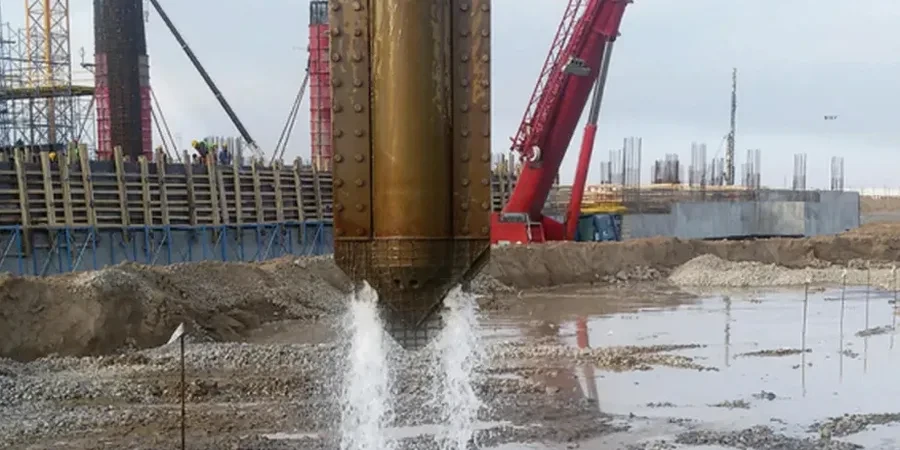
Local geotechnical conditions in Waterford
The most common mistake we see on Waterford sites is treating vibrocompaction as a standardised recipe—same grid, same energy, same depth—regardless of what the CPT logs actually show. That approach fails where the loose layer pinches out or where a silt lens interrupts the compaction front. You get uneven settlement. Cracks follow. The other error is skipping post-treatment verification. Without a before-and-after CPT comparison, there is no proof the ground improved. On one Ferrybank project, we found a 40% density gain in the upper 4 metres but only 15% at 6 metres—the deeper interval needed a reduced grid. That adjustment prevented differential settlement under a heavily loaded slab. Designing vibrocompaction means reading the ground, not just running the rig.
Our services
We deliver vibrocompaction design as part of a wider ground improvement strategy. Each service below addresses a specific condition we encounter across Waterford and the southeast.
CPT-based density profiling
We run cone penetration tests on a tight grid before any design work begins. The CPT data defines the loose zones, layer boundaries, and baseline tip resistance. After treatment, repeat CPTs confirm the densification achieved at each probe location.
Grid and energy specification
Based on the pre-treatment CPT profile, we specify triangular or square grid geometry, probe depth, vibrator power, and dwell time per metre. The spec accounts for groundwater level, fines content, and proximity to existing structures.
Post-treatment verification and sign-off
We overlay before-and-after CPT plots to quantify improvement. The report includes settlement estimates under design load, lateral extent of treatment, and compliance with the project's performance specification.
Questions and answers
What does vibrocompaction design cost in Waterford?
Design fees for a typical vibrocompaction project in Waterford range from €1,410 to €4,920, depending on site area, number of CPT verification points, and treatment depth. Small commercial plots fall at the lower end; larger industrial or residential schemes with multi-depth targets and seismic requirements sit at the upper end. The fee covers pre-treatment investigation planning, grid and energy specification, and post-treatment verification reporting.
How deep can vibrocompaction work in Waterford's ground conditions?
We routinely design for depths up to 25 metres. On Waterford's glacial till and fluvial deposits, the effective depth depends on the continuity of the loose sand layer. Where silt interbeds are present, compaction energy attenuates and we adjust the grid or combine the treatment with stone columns at the transition zone.
Is vibrocompaction suitable for sites near the River Suir?
Yes—many North Quays and Ferrybank sites sit on loose alluvial sands and reclaimed fill. Vibrocompaction works well there, but groundwater is high and treatment depth must extend below the water table. We factor this into the design and monitor pore pressure response during the trial probe to avoid liquefaction during compaction.