In Waterford, we often walk sites near the River Suir and see stiff glacial tills sitting directly on limestone bedrock, which can transmit seismic waves very efficiently. While Ireland is not known for extreme seismicity, the Irish National Annex to Eurocode 8 still requires a design ground acceleration of 0.04g for the region, and the long-period energy from distant offshore events can pose a real threat to flexible structures. What catches many engineers off guard is that the soft alluvial clays in parts of Ferrybank and along the city's southern quays can amplify this motion, creating a dynamic response that standard fixed-base design struggles to handle. Our approach to base isolation starts by decoupling the superstructure from these ground motions, using elastomeric or sliding bearings that are tuned specifically to the stratigraphy we log on each borehole. This is not an off-the-shelf solution; it requires a deep understanding of how Waterford's geology interacts with low-to-moderate seismicity, which is where our track record in projects across the southeast comes into play.
Effective base isolation in Waterford hinges on accurately mapping the limestone bedrock profile, not just on selecting the right bearing type.
Technical details of the service in Waterford
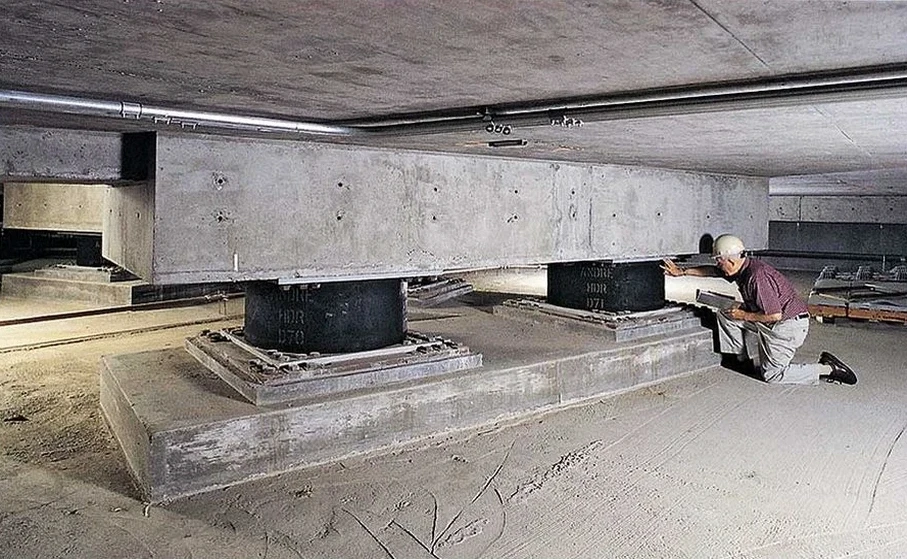
Local geotechnical conditions in Waterford
With a population of over 53,000 and growing pressure to build on brownfield sites along the River Suir, Waterford faces an increased risk of constructing on softer ground where spectral acceleration can be amplified. The main danger we see is a non-linear response in the upper soil layers during a rare 475-year return period event, which can generate inter-story drift ratios exceeding the 0.5% limit in non-isolated hospitals or data centres. Failing to isolate a critical facility here doesn't just mean structural cracking; it risks the total loss of post-earthquake functionality, which is unacceptable for the regional emergency response infrastructure. Another subtle risk is the torsional irregularity that arises when isolators are placed on variable-depth bedrock, a condition we encounter frequently near the old Viking triangle where the topography has been heavily modified over centuries.
Our services
Our service package aligns with the performance requirements of Eurocode 8 and the specific demands of the Irish construction sector.
Nonlinear Time History Analysis
We build 3D models in ETABS or SAP2000 incorporating site-specific accelerograms matched to the Irish National Annex spectrum to verify the isolator's hysteretic behaviour and the superstructure's elastic response.
Prototype Test Specification
We draft the full testing protocol according to EN 15129 Annex B, including the ageing, scragging, and real-time dynamic tests that must be witnessed at the manufacturer's facility before installation.
Construction Phase Inspection
Our team supervises the setting out and levelling of the isolation plane on site in Waterford, checking the grouting of bearing plates and the integrity of the seismic gap before any works are connected across the interface.
Questions and answers
How much does a base isolation design for a building in Waterford typically cost?
The engineering design and analysis package for a typical mid-rise project in Waterford generally falls between €4.320 and €8.740, excluding the supply and installation of the isolation devices themselves. The final figure depends on the number of isolators, the complexity of the superstructure, and whether a nonlinear time history analysis is required.
Is base isolation necessary in Ireland given the low seismicity?
Ireland's seismicity is low to moderate, but the soft alluvial soils found in parts of Waterford can amplify ground motion significantly. For essential facilities, hospitals, and high-value commercial buildings, the cost of isolation is often justified by the protection of operational continuity and the reduction in structural damage during a rare event.
What type of ground investigation is needed before designing the isolation system?
We require a thorough geotechnical investigation with boreholes extending into competent bedrock, typically limestone at depth in Waterford. This must be paired with geophysical surveys, such as down-hole seismic testing, to obtain the shear wave velocity profile needed for site response analysis according to Eurocode 8.
How do you account for the tidal influence of the River Suir on the foundation design?
The tidal range of the Suir estuary can influence the groundwater regime in the near-surface alluvium. We incorporate seasonal groundwater monitoring data into our soil-structure interaction models to ensure that the dynamic properties of the foundation soil are not overestimated during high-water conditions.
What is the design life of a base isolation system in an Irish climate?
Designed to EN 15129, the elastomeric bearings have a nominal service life of 50 years. In Waterford's damp maritime environment, we specify enhanced edge cover and protective coatings to prevent ozone and moisture degradation, and we include an inspection regime to monitor the bearings over the structure's lifespan. More info.