A recent three-storey apartment block development on the Cork Road required a complete redesign of its foundation concept after initial site tests revealed a lens of soft alluvial clay beneath the upper gravels. The structural engineer had assumed competent bearing strata at 1.2 metres, but the reality of Waterford’s post-glacial geology demanded a more rigorous approach. This is precisely why shallow foundation design in the Suir Valley cannot rely on desktop assumptions alone. Our team integrates in-situ testing with laboratory analysis to verify bearing capacity, settlement potential, and the risk of differential movement before a single pour. For sites where the upper crust is thin, we often recommend supplementing the investigation with test pits to visually log the transition from made ground into natural deposits, ensuring the proposed footing elevation is founded on consistent material.
Bearing capacity in Waterford’s glacial tills is rarely uniform across a single footprint, making a detailed ground investigation the only reliable basis for a safe shallow foundation design.
Technical details of the service in Waterford
Working video
Local geotechnical conditions in Waterford
The ground profile beneath Waterford city centre differs markedly from the elevated drumlin sites on the western outskirts. In the low-lying areas near the Quays, a sequence of estuarine silts and soft organic clays overlies the glacial till, presenting a significant risk of long-term consolidation settlement under even modest foundation loads. Conversely, the boulder clay formations at higher elevations near University Hospital Waterford exhibit high bearing strength but can contain erratic cobbles and lenses of water-bearing sand that complicate excavation. The most critical risk in shallow foundation design across the region remains the undetected variation in stratum thickness, which can lead to differential settlement severe enough to crack masonry within the first five years of service. A conservative design approach, supported by an adequate number of exploratory points as defined in the National Annex to Eurocode 7, is essential to mitigate this hazard.
Our services
Our shallow foundation design package in Waterford is structured to take a project from initial feasibility through to detailed construction drawings, ensuring full compliance with Building Control (Amendment) Regulations. Each phase is executed by a chartered geotechnical engineer with direct track record of the local ground conditions.
Bearing Capacity and Settlement Analysis
We calculate the ultimate and allowable bearing capacity using both analytical methods (Brinch Hansen, Vesic) and finite element modelling, incorporating the partial factors from I.S. EN 1997-1 National Annex. Settlement analysis covers both immediate elastic settlement and time-dependent consolidation, with outputs formatted for direct inclusion in the structural engineer's design package.
Foundation Type Recommendation Report
Based on the ground investigation data, we compare viable shallow foundation options, from isolated pad footings through combined strip footings to a full raft slab. The report includes a cost-benefit assessment, an evaluation of construction risk, and a clear justification for the recommended foundation type, referencing the specific ground model developed for your Waterford site.
Construction Stage Monitoring and Verification
We deliver on-site supervision during excavation to confirm that the ground conditions match the design assumptions. This includes plate load testing on the formation level, inspection of the bearing stratum by an experienced geotechnical engineer, and sign-off documentation for the Assigned Certifier under BC(A)R SI.9.
Questions and answers
What is the typical cost of a shallow foundation design package for a single house in Waterford?
For a standard single dwelling in the Waterford area, a complete shallow foundation design package, including a desk study, a limited site investigation, laboratory testing, and the production of a detailed design report, typically ranges from €1,560 to €2,590. The final cost depends on the complexity of the ground conditions and the number of exploratory points required to satisfy the Assigned Certifier.
How deep do strip footings need to be in Waterford to avoid frost action?
While frost penetration in Ireland is relatively shallow compared to continental Europe, the standard minimum founding depth for external strip footings in Waterford is 900 mm below finished ground level. This depth ensures the bearing stratum is below the zone of significant seasonal moisture variation and provides adequate protection against the rare severe frost event, in line with the recommendations of I.S. EN 1997-1 and standard Irish building practice.
Can you design shallow foundations on the soft alluvial ground near the River Suir?
Founding directly on the soft estuarine silts and alluvial clays found in the low-lying areas of Waterford is generally not feasible for conventional shallow foundations due to low bearing capacity and high settlement potential. Our approach in these zones typically involves either excavating through the soft material to bear on the underlying glacial till, or designing a stiffened raft foundation. In some cases, we may recommend ground improvement techniques or a piled solution if the competent stratum is too deep.
What is the difference between a spread footing and a raft foundation, and which is more suitable for Waterford's soils?
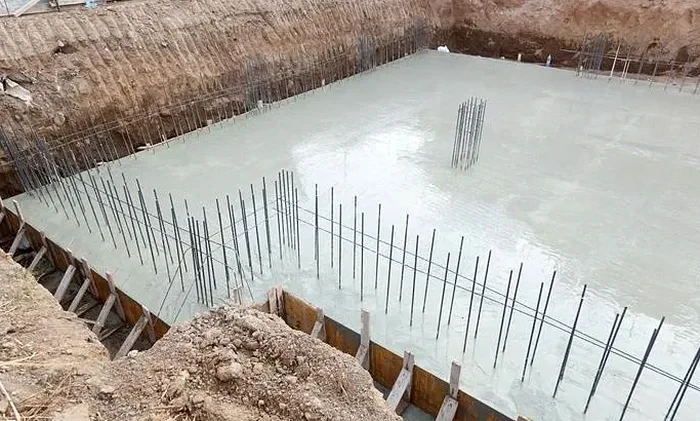
A spread footing is an isolated or strip base that distributes a column or wall load directly onto a limited area of soil, while a raft foundation is a continuous slab covering the entire building footprint, designed to bridge soft spots and reduce differential settlement. On the competent boulder clays prevalent across much of Waterford, well-designed strip footings are usually the most economical solution. However, on the more variable ground in the river valleys, a raft foundation offers greater robustness and is often the recommended option when the bearing stratum is inconsistent.