The underlying ground conditions across Waterford city and its outskirts pose a specific challenge for rigid pavement design. Much of the commercial and industrial development sits on glacial till overlying Lower Palaeozoic shales and sandstones, with the River Suir corridor introducing soft alluvial silts and clays that can vary in depth by several metres over short distances. Without a soil investigation that captures this variability, a concrete pavement slab is at risk of differential settlement. The team links the structural design of the pavement to the stiffness of the subgrade, obtained through in-situ testing and laboratory classification. In areas near the old port or along the Tramore Road, made ground adds another layer of complexity that must be quantified before any joint layout or slab thickness is finalised. A well-designed rigid pavement in Waterford starts with a clear picture of what lies beneath the surface. For projects where the subgrade is particularly weak, the stone columns technique is often evaluated as a ground improvement method prior to pavement construction.
A rigid pavement slab only performs as well as the soil it rests on. In Waterford's glacial till, that means testing, not guessing, the subgrade stiffness.
Technical details of the service in Waterford
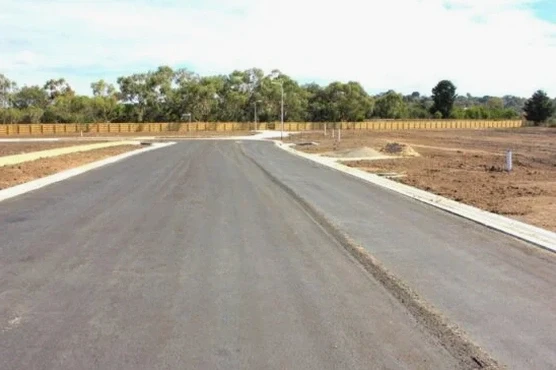
Local geotechnical conditions in Waterford
A 20-tonne plate load test rig is set up on the prepared subgrade at the exact elevation of the underside of the concrete slab. The test applies incremental pressure through a 762 mm diameter plate, and the resulting deflection is recorded to calculate the modulus of subgrade reaction. In Waterford, skipping this step because the till "looks firm" has led to longitudinal cracking within the first two years of service on more than one industrial yard. The risk is not theoretical. Soil moisture content under a sealed concrete slab can increase over time due to capillary rise from the water table, softening the upper layer of till and reducing its bearing capacity. A conservative design accounts for this equilibrium moisture condition. For access roads serving wind farm components coming through Belview Port, the heavy vehicle load repetitions demand a fatigue analysis of the concrete that is directly linked to the soil's elastic response. A poorly characterised subgrade leads to corner breaks, faulting at joints, and ultimately the need for full-depth slab replacement.
Our services
The rigid pavement design service covers the full geotechnical and structural interface, from site investigation planning to joint detailing. The scope is tailored to the specific soil profile and traffic loading of each Waterford project.
Site Investigation for Concrete Pavements
Planning and execution of boreholes, dynamic probing, and trial pits to characterise the soil profile across the pavement footprint. Includes laboratory classification of the glacial till to assess its suitability for cement stabilisation.
Plate Load Testing and k-value Determination
In-situ determination of the modulus of subgrade reaction using a 762 mm diameter plate, performed on the prepared subgrade. The data feeds directly into the slab thickness design and joint spacing calculations.
Pavement Structural Design and Jointing Plan
Calculation of concrete slab thickness, dowel bar diameter and spacing, and tie bar layout based on the measured k-value and the design traffic loading in accordance with TII and Eurocode 2.
Questions and answers
What is the difference between rigid and flexible pavement design from a geotechnical perspective?
Rigid pavements distribute traffic loads through the flexural strength of the concrete slab, so the critical soil parameter is the modulus of subgrade reaction (k) rather than the CBR. The subgrade must deliver uniform support; point loads on the slab are transferred to a much wider area of soil. A flexible pavement, in contrast, relies on the bearing capacity of each layer and is more tolerant of minor differential settlement.
How much does a plate load test for rigid pavement design cost in Waterford?
A plate load testing programme for a typical rigid pavement project in Waterford, involving multiple test locations and a full report with k-value derivation, ranges from €1,770 to €5,370 depending on the number of tests, site access, and the depth of any trial pits required to reach the subgrade level.
Why is the water table in Waterford a concern for concrete pavements?
The water table along the Suir valley is relatively high, and the glacial till can be moisture-sensitive. After a concrete slab is placed, evaporation from the soil surface stops, and the moisture content beneath the slab can increase over time. This softening reduces the k-value and can lead to pumping at joints if the subgrade is not adequately drained or stabilised.
What joint spacing is typically used for industrial yards in Waterford?
For industrial yards and container storage areas on the glacial till around Waterford, contraction joint spacing is typically set between 4.0 and 5.5 metres, with the exact spacing calculated from the slab thickness and the measured subgrade friction. Dowel bars are specified at all contraction joints to ensure load transfer efficiency under heavy forklift and HGV traffic.