The tidal stretches of the River Suir have shaped Waterford’s subsurface into something the casual observer never sees: deep, compressible alluvium and soft estuarine clays that make conventional foundations a gamble. When you drive a rigid footing into that kind of ground without treatment, differential settlement shows up within a year — doors jam, brickwork cracks, and the job turns into a callout nightmare. That’s where a properly engineered stone column design changes the equation entirely. Instead of excavating metres of muck or specifying costly deep piles for a modest commercial slab, we install compacted gravel columns that reinforce the mass and speed up drainage. Around the city, from the quayside developments near the Clock Tower to the light industrial units spreading west toward Kilmeaden, we see the same story: soft silts down to six or seven metres, groundwater at minus two, and a client who needs a floor slab that stays flat. Stone column design in Waterford is about reading those borehole logs and turning a problem stratum into a working platform, all while keeping the programme tight and the neighbours undisturbed.
A stone column is not a pile — it is a soil reinforcement element that doubles the mass stiffness and drains the water at the same time.
Technical details of the service in Waterford
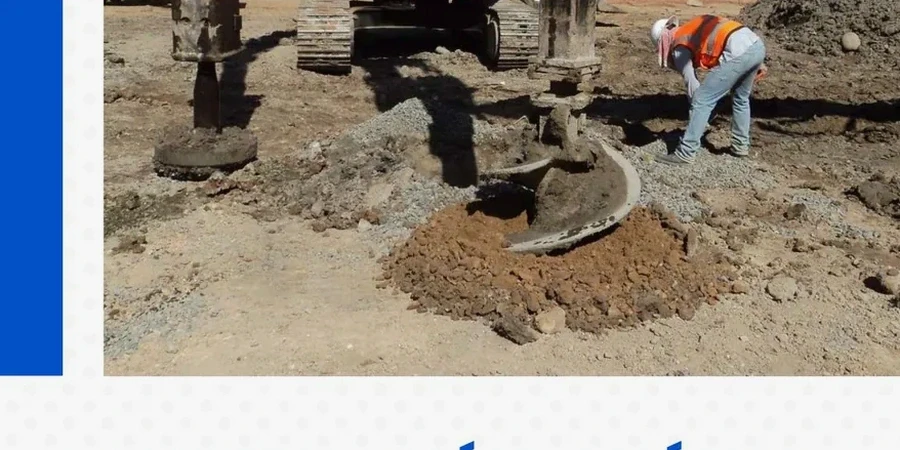
Local geotechnical conditions in Waterford
Skipping a site-specific stone column design in Waterford is a gamble with the tide. The soft alluvium along the Suir isn’t uniform — one borehole can hit dense sand lenses while the next, twenty metres away, finds organic silt with a moisture content above the liquid limit. If you just copy a generic grid spacing from a brochure, you end up with columns that either don’t lock up laterally or fail to intercept the weakest pockets. We have seen jobs where the contractor installed columns without a proper design, the plate load test failed at 80% of the target, and the whole floor had to be redesigned as a suspended slab — at triple the cost. The design has to account for the groundwater regime too: in Waterford, the river level fluctuates with the tide, and a column that isn’t taken deep enough into the bearing stratum can lose confinement when the water table rises. Our approach pairs the stone column design with CPT or SPT data from every column location, so the vibrator operator knows exactly when to stop. That level of rigour is what keeps a light industrial unit on the Tramore Road crack-free five years later, while the untreated shed next door has a doorframe you can’t close in winter.
Our services
Our Waterford ground improvement package covers the full stone column lifecycle, from investigation to verification. We keep the process lean: you talk to one engineer, get one design package, and deal with one field crew.
Site investigation for stone columns
CPT and SPT campaigns across your Waterford plot to map the soft layers and confirm depth to competent bearing stratum. We log every metre and produce a ground model you can build on.
Stone column design package
Grid layout, column diameter, depth, backfill gradation, and settlement predictions — all calibrated to your specific loads and the borehole data from your site.
Post-installation verification
Plate load testing on completed columns, zone load tests where required, and settlement monitoring to prove the ground meets the design stiffness before you cast the slab.
Vibro-compaction alternative assessment
For granular fills and looser materials around the city’s industrial estates, we evaluate whether vibro-compaction is a faster solution and design the compaction grid accordingly.
Questions and answers
How much does stone column design and installation cost for a typical Waterford site?
For the design and ground investigation phase, plus installation of stone columns on a typical commercial plot in Waterford (say 200–400 m²), budget between €1,190 and €4,640. The spread depends on depth to bearing stratum, grid density, and mobilisation costs. A site on the quays with deeper soft clay will track toward the upper end, while a shallow treatment on a Kilcohan plot lands lower. We give a fixed-price design quote after the first borehole log.
What ground conditions in Waterford make stone columns necessary?
The soft estuarine silts and alluvial clays along the River Suir floodplain. Many areas around the city centre, Ferrybank, and the western industrial estates have compressible layers between three and ten metres deep. Stone columns reinforce these weak soils so they can support floor slabs and light structures without excessive settlement.
How do you verify that the installed columns are working?
We run plate load tests on individual columns and sometimes on groups of three, measuring settlement under staged loading up to 150% of the design load. We also take the modulus from the load-settlement curve and compare it to the design prediction. If the numbers don’t match, we adjust before the slab goes in.
What is the difference between stone columns and vibro-compaction?
Stone columns add material — they replace weak soil with compacted gravel in a defined column. Vibro-compaction densifies existing granular soils without adding backfill. In Waterford, stone columns are the go-to for cohesive silts and clays; vibro-compaction works better in loose sands and gravels, which are less common in the city centre but appear in some outlying areas.
How long after stone column installation can we start building?
The columns themselves are load-ready immediately after compaction. However, the accelerated drainage effect means excess pore pressures in the surrounding clay dissipate within weeks rather than months. We typically recommend a four-week wait before pouring the floor slab, confirmed by settlement monitoring readings on site.