Waterford’s development along the Suir estuary means groundwater is rarely far below the surface. With the city’s population now exceeding 53,000 and growing, new commercial and residential projects frequently encounter silty alluvium, glacial till, and locally fractured shale bedrock—materials where permeability can vary by orders of magnitude across a single site. Guessing the infiltration rate isn’t an option when designing basements, attenuation systems, or deep excavations near the Quays. Our team runs IS EN ISO 22282-compliant field permeability tests, applying the Lefranc method in soil and the Lugeon method in rock, to give engineers the in-situ hydraulic conductivity values they actually need for dewatering plans, cut-off wall design, and groundwater control during construction.
A single Lugeon value of 2 versus 20 Lu changes the entire grouting strategy—Waterford’s fractured bedrock doesn’t average out, it demands depth-specific measurement.
Technical details of the service in Waterford
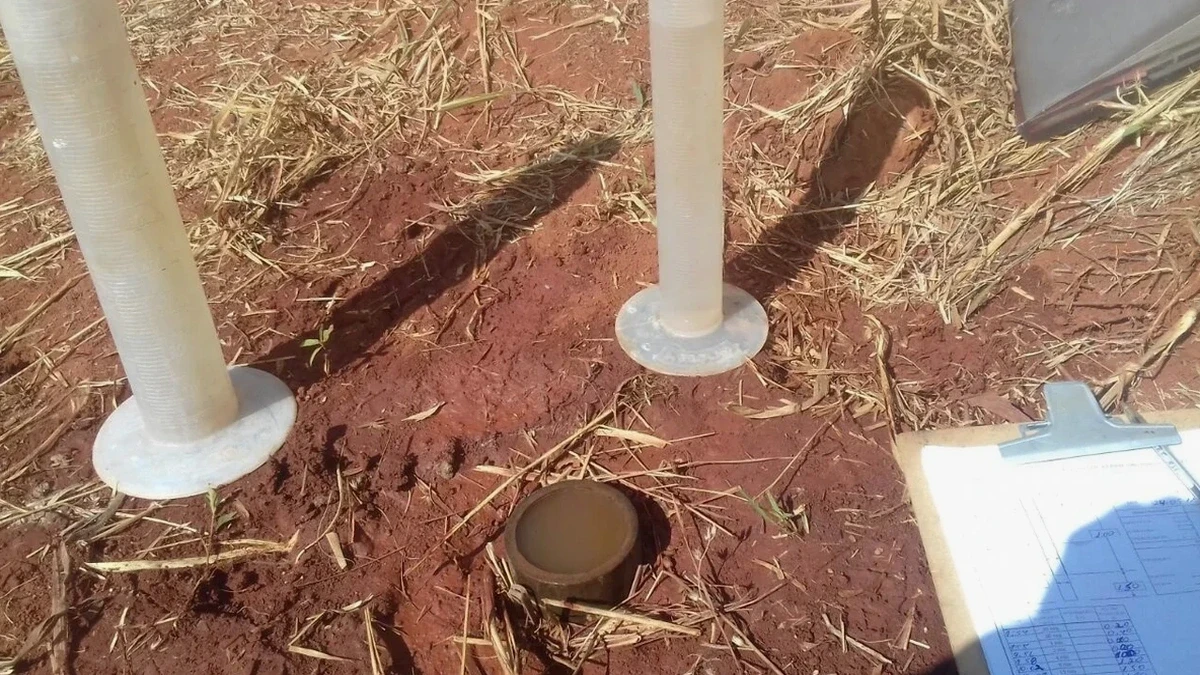
Local geotechnical conditions in Waterford
The hydraulic contrast between Waterford’s northern suburbs—like Ferrybank, where glacial till dominates—and the city centre along the Quays couldn’t be sharper. Ferrybank’s stiff, clay-rich tills often yield k-values in the 10⁻⁸ to 10⁻¹⁰ m/s range, making drainage a slow affair. But move south toward the Rice Bridge area, and the alluvial sands and gravels of the Suir floodplain can transmit water at 10⁻⁴ m/s or faster. Without field testing, a designer might assume intermediate values and get both dewatering volumes and settlement predictions wrong. The Lugeon test in the region’s shale and sandstone bedrock carries its own risk: steeply dipping joints can connect to the estuary, and a single test interval that bridges a tight and an open fracture will produce a misleading average. Our protocol runs short test intervals and checks pressure-flow linearity to flag dilatancy or turbulent flow before the numbers go into the report.
Our services
Our field permeability work in Waterford covers the full range of in-situ hydraulic testing, from shallow soil investigations to deep rock pressure tests. Every test programme is supervised by an experienced field engineer who logs the response in real time and adjusts the test sequence if the formation behaviour is outside expected bounds.
Lefranc variable-head testing
Falling and rising head tests in soil boreholes, ideal for the silty sands and glacial tills common across Waterford. We use standpipe and pressure transducer monitoring for accurate k-value determination between 10⁻⁵ and 10⁻⁸ m/s.
Lugeon packer testing in rock
Single and double packer tests in NX to HQ boreholes, following the classic 5-stage pressure cycle. Applied to shale, sandstone, and limestone bedrock for dam feasibility, tunnel alignment, and deep basement dewatering studies.
Combined soil-rock permeability profiling
Sequential Lefranc and Lugeon testing in the same borehole when the site stratigraphy transitions from overburden to bedrock. Critical for cut-and-cover excavations along the Suir corridor.
Pumping test supervision and data interpretation
Constant-rate and step-drawdown pumping tests with observation wells for larger Waterford developments requiring aquifer-scale parameters. Includes Theis and Jacob straight-line analysis with recoverability assessment.
Questions and answers
How much does a Lefranc or Lugeon test cost in Waterford?
For a single Lefranc test at one depth interval, the cost typically falls between €570 and €810 when performed as part of a wider site investigation programme. A full Lugeon profile with five pressure stages in rock runs higher due to the packer rig time. The final figure depends on borehole depth, number of test intervals, and access conditions on site.
When should I specify a Lugeon test instead of a Lefranc test?
The Lugeon test is designed for rock mass permeability, using a packer to isolate a section of borehole and applying water under pressure. You need it when the ground is bedrock—shale, sandstone, limestone—and the hydraulic conductivity is governed by fractures and joints rather than pore space. The Lefranc method is for soils and very weak rock where the borehole wall can be kept open without a packer.
What’s the difference between constant-head and falling-head Lefranc tests?
Constant-head tests maintain a fixed water level in the borehole and measure the flow rate required to sustain it; they’re better for more permeable soils like sandy gravels. Falling-head tests let the water level drop naturally and track the decline over time, which suits lower-permeability silts and clays. We select the method based on the formation encountered during drilling.
Can field permeability tests replace lab permeameter tests?
They complement each other, but they don’t replace one another. Lab tests on undisturbed samples give you the matrix permeability of a small specimen, while field tests capture the bulk mass permeability including fissures, root holes, and gravel lenses that dominate real groundwater flow. For any Waterford site where dewatering or groundwater control is critical, we always recommend in-situ testing alongside lab work. More info.